


CareOne TrueCare · Distributor Program 2026
One cream. Up to ₹30,00,000 a year.
The pack carries MRP ₹999. Your cost lands between ₹382 and ₹322 a tube depending on order size — so ₹617 to ₹677 stays with you on every tube. ₹30 lakh a year is what ~370 tubes a month looks like at the top rate; the slider below works out your own number. Start with just 100 pieces, get up to 150 tubes free, and we buy back whatever doesn't sell.
4.6 5,247 reviews
50,000+ tubes sold
2% return rate
Made in India
You earn (margin alone)
₹15,00,000
per year · Gold Partner
₹658
profit / tube
66%
trade margin
+ free stock · free freight · 90-day buyback
₹677
profit per tube (Platinum)
150
tubes free on your first order
₹999
MRP printed on every pack
90 days
unsold buyback guarantee
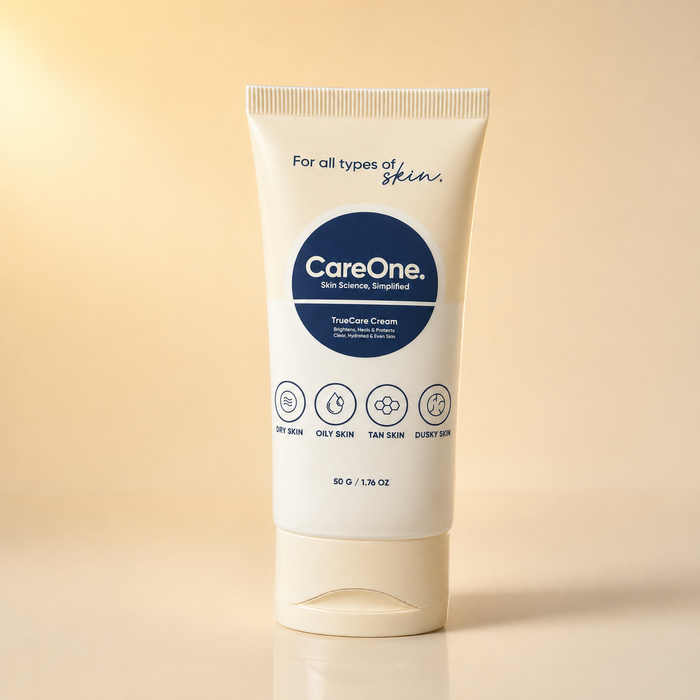
A real, proven brand
Not a new gamble — a brand already selling across India.
You're stocking a product customers already know — rated 4.6 by 5,247 buyers.
Already live on
AmazonFlipkartJioMartcareone.in
Made in India
GMP-certified unit
UDYAM registered
GST invoiced
22 active ingredients
The whole plan on one screen

The rate card. No hidden slabs, no per-person deals.
Pick your first order size. That one choice sets your rate, your free stock and your margin — and it stays the same for every reorder.
“Real cost / tube” is what you actually pay once the free stock is counted in — e.g. 100 tubes at ₹420 plus 10 free = ₹42,000 for 110 tubes = ₹382 a tube. Rates are before GST. Freight is on us.
If you sell at MRP yourself
Your own shop, counter or direct customers. Customer pays ₹999, your cost is ₹382–₹322, so ₹617 to ₹677 a tube is yours. This is the number in the table above.
If you wholesale to retailers
You give the retailer the tube at about ₹560. You keep ₹178 a tube. He keeps ₹439 if he sells at the printed MRP of ₹999, or about ₹339 if he matches our website price of ₹899 — either way far more than the 10–15% most creams give him. Smaller per tube for you, but far bigger volume.
Most partners do both — sell at MRP where they have their own counter, and wholesale the rest. Your yearly number comes from how many tubes you move, not from the tier name. Work it out on the slider below.

The part nobody explains
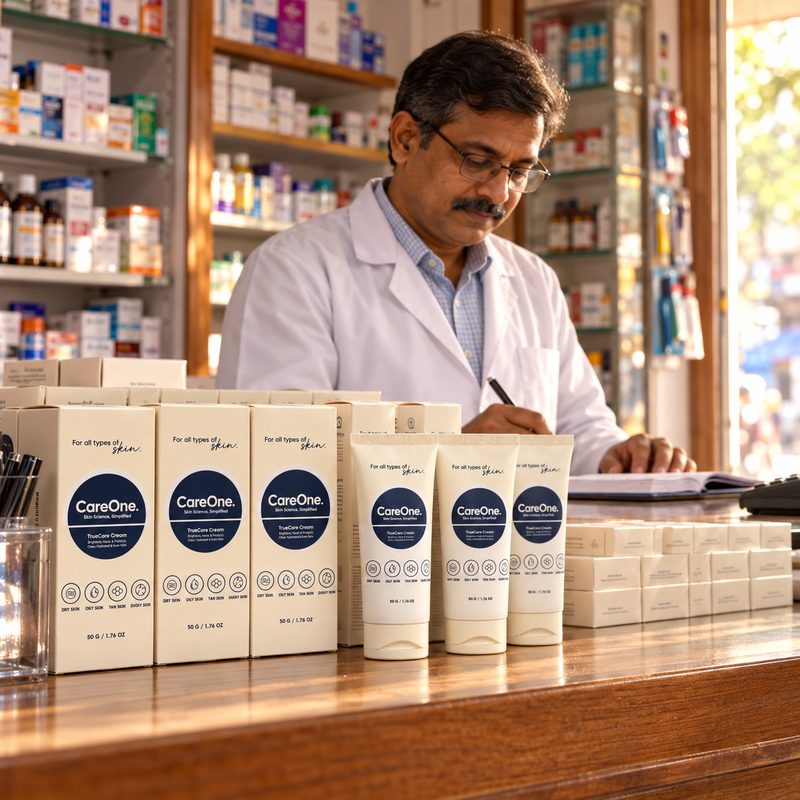
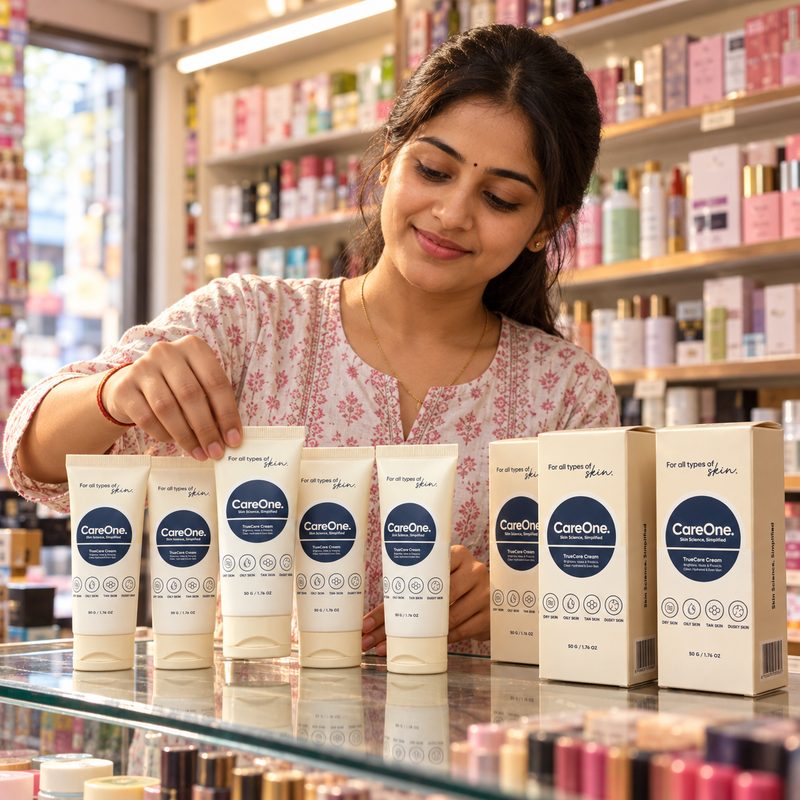
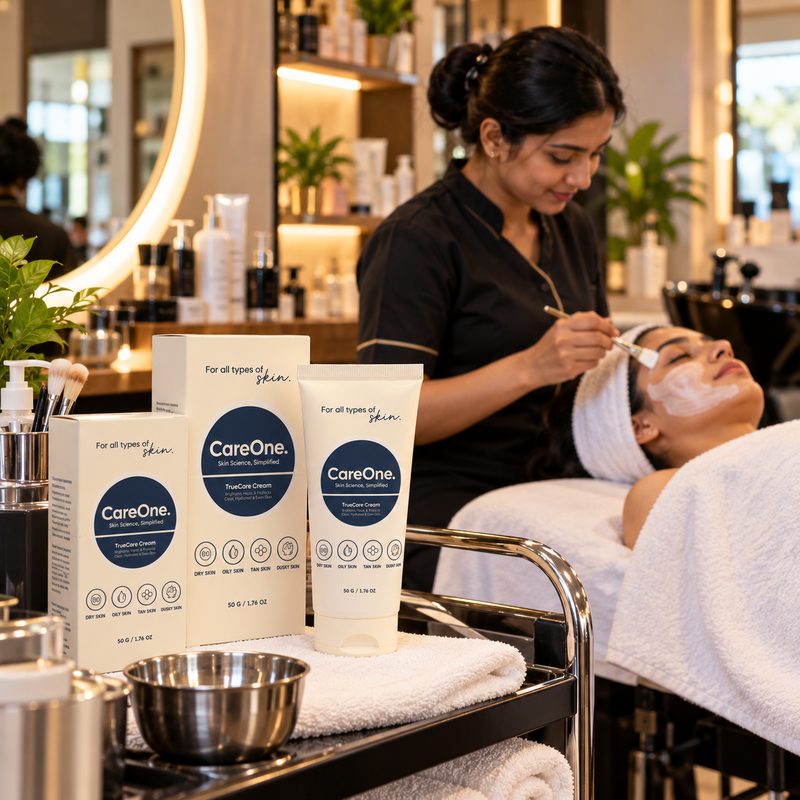
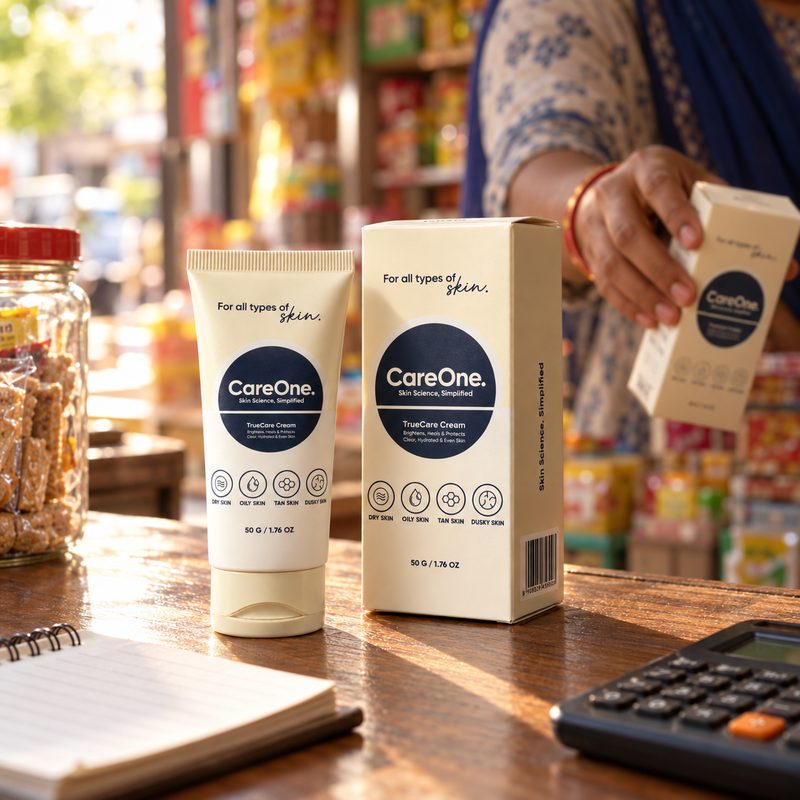
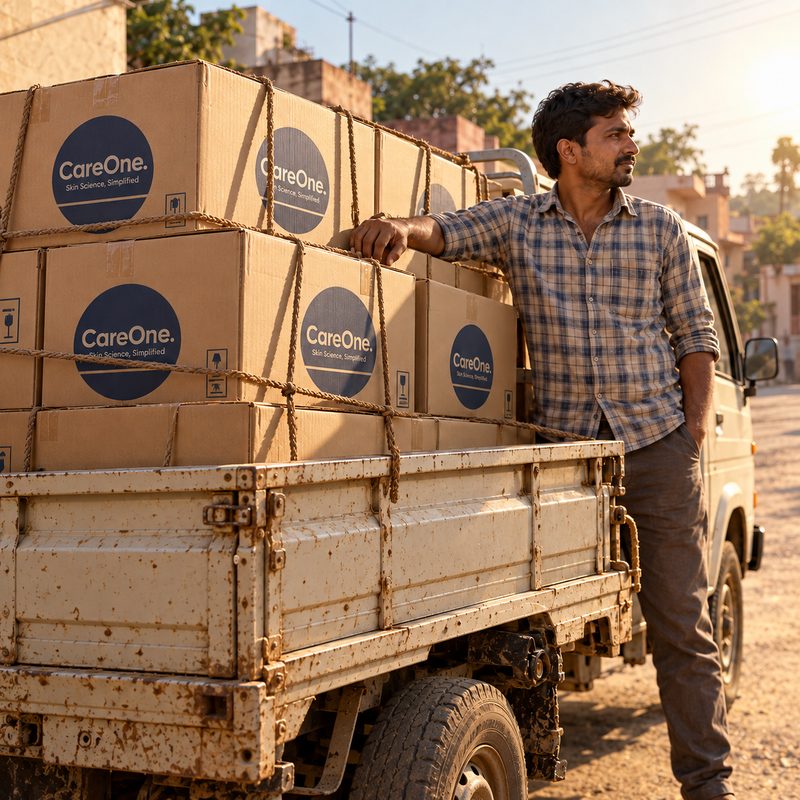
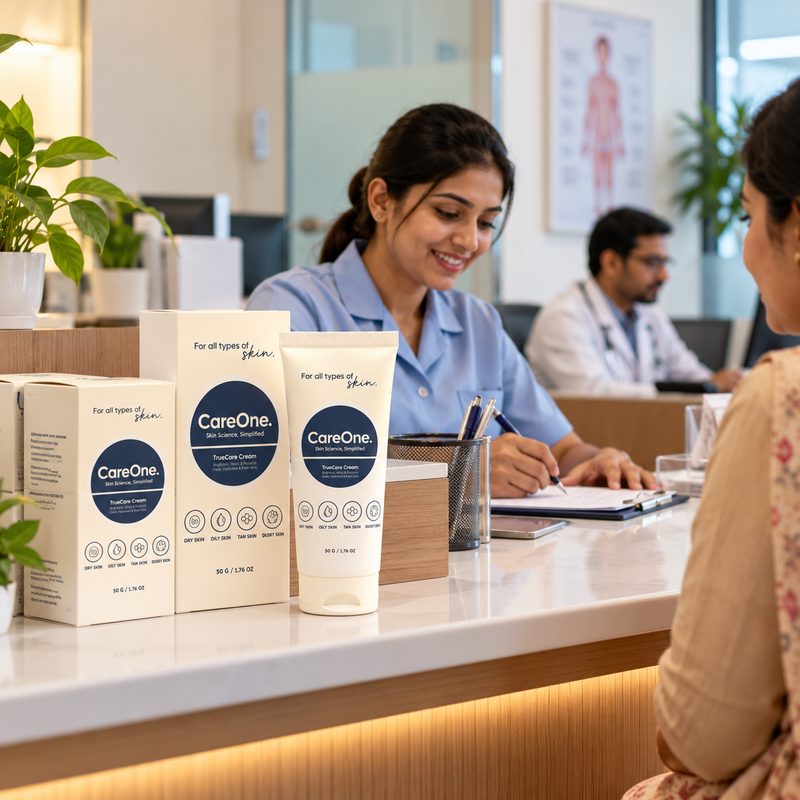
So who actually buys it from you?
Margin only matters if the stock moves. These are the six counters an Indian skincare distributor actually sells through — and the first 100 tubes only need about ten of them.
Chemists & pharmacy counters
The biggest single channel for a ₹899 treatment cream. A chemist already sells skincare, already answers “kuch de do daag ke liye”, and keeps 44% on every tube. Start with the 10–15 counters closest to you.
Beauty stores & cosmetic shops
Walk-in customers who came looking for skincare. One tube on a visible shelf with a display board does most of the work; the MRP printed on the pack stops any haggling.
Salons & parlours
They recommend before they sell. A parlour that puts it on a client’s face becomes a repeat buyer of 10–20 tubes a month, and their word carries more weight than any ad.
Your own counter
If you already run a shop, this is the highest-margin route — you keep the full ₹617 to ₹677 instead of ₹178, because there is no retailer in between.
Sub-stockists in nearby towns
Once your own town is running, the same rate card lets you supply smaller dealers in towns around you. No territory is locked, so nothing stops you from growing outward.
Doctors’ and clinics’ front desks
A barrier-first cream with a published INCI list and lab reports is an easy recommend for a dermat or a general physician who is tired of prescription-only options.
What the first 100 tubes actually look like
Twelve counters. Seven to nine tubes each. A tube finishes in about 30 days, so the counters that sold out come back to you in the second month — that is the whole business. You are not chasing 100 customers; you are keeping a dozen shopkeepers stocked.
Why your counter does not get undercut
Quick-commerce is what kills a distributor — a 10-minute app selling the same tube cheaper than his shop. We pulled CareOne off quick-commerce and kept it off. MRP ₹999 is printed on every pack, and our own website sells at ₹899, so the floor under your retail price is public and stable.
Count your own money
Slide it. See exactly what you'll earn.
300 tubes / month
501,000
Your profit, every month
₹1,92,600
≈ ₹23.1 Lakh / year
Tier: Silver · at MRP ₹999 · your tier comes from a quarterly reorder of that volume · through a retailer instead = ₹178/tube
8 ways the money flows to you
Join once. Earn from eight directions.
62–68%
Trade margin
Big brands give 45–55% off MRP. We give more.
FREE
+15%
Launch stock bonus
Free stock on your first order.
FREE
City marketing
We run ads in your area once you reorder.
₹370
Lower landing at volume
Order more → pay less per tube.
FREE
Display & glow-signs
We fund retailer branding.
24h
Dispatch in 24 hours
Orders up to 10,000 tubes ship the next working day.
Damage replaced free
Broken in transit? We replace it.
Zero-risk buyback
Unsold stock? We buy it back.

Built for Indian retail — pharmacies, beauty stores, super-stockists.
A 50g tube finishes in ~30 days. The customer who buys once comes back every month — that's a reorder business, not a one-time sale.
CareOne vs everyone else
More margin. Marketing included. Stock guaranteed.
| What matters to you | Typical brand | CareOne |
|---|---|---|
| Your margin | 45–55% off MRP | 62–68% |
| Online price war | Yes — kills you | No — MRP ₹999 on every pack |
| Marketing | You pay | We run ads in your city |
| Unsold stock | Your loss | 90-day buyback |
| To start | Big deposit | Just ₹42,000 (100 tubes) |
Start in 3 steps
From this page to your first profit — fast.
1
Send the form
We call within 24 hours with your city's earning plan.
2
Small pilot order
₹42,000, 100 tubes. Validate before you scale.
3
Sell & repeat
We start ads in your area. You start earning.
The boring page, in full

The terms, before you ask for them.
Every question a distributor asks on the second call. Written down here so you can decide without one.

Payment
100% advance by bank transfer. We raise a proforma invoice, you transfer and send the UTR, stock ships against it. No payment gateway, so nothing is deducted from either side.
GST — read this before you order
Rates are before GST. With a GSTIN you claim the input credit and your real cost is the rate in the table. Without a GSTIN that 18% is yours to absorb — ₹420 effectively becomes about ₹496 a tube. A GSTIN is required for orders of 500 tubes and above, and worth having even at 100. Get it first; it changes the whole maths.
Dispatch
Orders up to 10,000 tubes ship within 24 hours of the UTR. Above that, allow about a week. Freight is on us, every order, every time.
Stock
About 10,000 units held ready, so a first order does not wait on production. Broken or leaked stock in transit is replaced free.
Unsold stock
Resaleable stock from your first order is bought back within 90 days. That is the clause most brands will not put in writing.
Territory & rate card
We do not lock territory or promise exclusivity — and the rate card is the same for everyone, so nobody gets better terms than you by asking louder. A written agreement is signed before your first dispatch.
Compare before you commit
How skincare distributorship works at the other Indian brands
If you are weighing a CareOne distributorship, you are almost certainly also looking at Mamaearth, Minimalist, The Derma Co, WOW Skin Science, Biotique or Himalaya. That is the right thing to do. Below is how those programmes are structured — the model, not invented margin figures, because nobody publishes those and we said on this page we would not make them up. Ask each brand the same four questions and compare the answers side by side.
Read the honest part — where CareOne is the weaker choice, and why we still say it
Where CareOne is honestly the weaker choice. We sell one product. A distributor carrying us does not get a range to fill a shelf with, cannot offer a customer three price points, and cannot lean on a brand name that every shopper already knows. If your business model depends on catalogue width, or on a name with twenty years of recall, Biotique or Himalaya will serve you better than we will. We are also a young brand, and a young brand carries risk an established one does not — which is exactly why the buyback exists and why the first order is 100 pieces rather than a thousand.
What we are actually offering instead. The reason one product can work as a distribution business is the same reason it works on a face. Ten separate products mean ten formulas that were never tested together — different pH levels, actives that cancel or irritate each other, several preservative systems on one skin. That is where barriers break, and the industry's answer is to sell the customer a "sensitive skin" range. TrueCare was built backwards from compatibility: only the 22 actives that stay stable alongside each other in a single base, with 47 harmful chemicals removed. For you that means one SKU to explain, one SKU to stock, one SKU to reorder — and a repeat customer every thirty days rather than a shelf of slow movers.
The complete guide
Skin care products distributorship in India — how it actually works
Written for first-time distributors. Whether you search for it as a skincare distributorship, a cosmetic distributorship, a cosmetic dealership or simply wholesale supply of face cream, the mechanics are the same — and so are the questions worth asking. No jargon, no inflated numbers: the real investment, the real profit margin, and what to check before you pay anyone.
How do you become a skin care distributor in India?
To become a skin care distributor in India you need four things: a GST registration, a clean dry storage space, working capital for a first stock order, and a signed rate card from the brand. Most skincare brands set a minimum first order between ₹25,000 and ₹5,00,000 depending on the territory you want. You buy stock at a trade price, sell at or below the printed MRP, and your income is the gap between the two. No licence or pharmacy qualification is needed for cosmetics sold as general merchandise — the brand's manufacturing licence covers the product itself.
What does a skincare distributorship cost to start — the real investment?
This is a low-investment business by distribution standards, because skincare is small, light and does not need cold storage or a godown. The investment splits into three parts, and honest brands will show you all three before you commit:
- Stock (the only real cost) — with CareOne this starts at ₹42,000 for 100 tubes, and 10 more tubes come free. There is no separate joining fee, security deposit or franchise fee.
- Storage — a 50 sq ft dry cupboard holds 1,000 tubes. Skincare is small and light, so most first-year distributors run it from an existing shop or a spare room.
- Working capital — retailers commonly pay in 15–30 days. Budget roughly one extra order's value so you are never stuck between a sale and a restock.
How much does a skin care distributor earn — and what profit margin is normal?
Your earning is profit margin × volume, nothing more exotic. In this category the trade margin is unusually wide, which is why cosmetic distribution attracts people who have never distributed anything before. CareOne TrueCare carries an MRP of ₹999 and a distributor buy price from ₹382, which leaves ₹617 to ₹677 on every tube — a 62% to 68% trade margin. That is high for the category because there is one product instead of a catalogue, so there is no slow-moving stock eating your capital. What decides your actual yearly number is turns, not margin: 100 tubes a month at the entry rate (₹617 a tube) is about ₹7.4 lakh a year; 300 a month at the ₹642 rate is about ₹23.1 lakh.
Which skincare brands offer distributorship in India — and how do you compare them?
Most Indian skincare and cosmetic brands run some form of distributor, dealership or super-stockist programme — from large listed groups to newer D2C labels. Rather than chase names, compare on five things that decide whether you make money:
- Trade margin on MRP — anything under 35% in skincare is thin once you pay for transport and credit.
- SKU count — a 40-product catalogue sounds generous but means 40 ways to hold dead stock. One or two fast movers is easier capital.
- Buyback on unsold stock — the single question most brands avoid. Ask for it in writing.
- Demand support — does the brand run ads in your area, or are you the entire marketing department?
- Price discipline — if the brand's own online listings routinely sit far below MRP, your retail counter cannot compete.
What documents do you need?
For a cosmetic products distributorship in India, keep these ready and you can usually be dispatched within a week: GST certificate, PAN card, Aadhaar or another address proof, a cancelled cheque or bank details for the account you will pay from, and your shop or firm registration if you have one. CareOne invoices every order with GST so your input credit is clean from the first shipment.
Red flags — when to walk away from a distributorship offer
- A joining fee, registration fee or refundable deposit before any stock moves.
- Income shown as a monthly figure with no volume attached to it.
- Earnings that depend on recruiting other distributors rather than selling product — that is not distribution.
- No written rate card, or a rate card that changes per person.
- No buyback clause and no answer when you ask what happens to unsold stock.
- No GST invoice, or an invoice in a different firm's name.
What are you actually stocking?
CareOne TrueCare is a 50g all-in-one daily face cream priced at ₹899 on careone.in against a printed MRP of ₹999 — roughly ₹30 a day for the customer. It carries 22 proven actives including Niacinamide 5%, Tranexamic Acid 3%, Alpha Arbutin 2% and Dual Hyaluronic Acid, and is free from 47 commonly-avoided chemicals. One tube lasts about 30 days, which is why counter reorders land monthly rather than quarterly. It is made in a GMP-certified, ISO 9001:2015 unit and every pack is GST invoiced. It is a moisturiser with UV filters in the base, not a tested sunscreen — we tell customers to use a separate SPF 30–50 on top, and we would rather you sell it that way too.
Before you pay anyone
Nine guides we wrote so you can check us — and everyone else.
Real numbers, no invented competitor figures, and the questions that expose a bad deal. Written in English and Hinglish. Read them before you commit money to any brand, including this one.
Skincare distributorship in India — the complete guide
Start here. What a distributor actually does, who it suits, documents, first order, and how to judge a brand.
Read the guide →Investment and margin, worked out in full
Stock, storage and working capital separated. What GST does to your per-tube cost, and a real first-six-months cash flow.
Read the guide →Is skincare distributorship actually profitable?
Profit = margin x turns minus freight, credit, dead stock. Where skincare beats FMCG — and where it bites.
Read the guide →Cosmetic distributor kaise bane — step by step
Hinglish guide: GSTIN, paisa, brand chunna, pehla order, counter pakadna, reorder.
Read the guide →Wholesale vs distribution — which model pays you more?
Sell at MRP yourself and keep Rs 617-677 a tube, or supply shops and keep ~Rs 178. The honest trade-off.
Read the guide →Chemist / medical store me skincare kaise beche
For shop owners: your margin, shelf placement, how much to stock, and the four things you must never claim.
Read the guide →How to find and vet cosmetic distributors in India
Distributor types, where they are actually found, and the nine questions to ask every brand before paying.
Read the guide →Mamaearth distributorship — how large-brand distribution works
No public franchise fee exists. What the FMCG chain looks like, and exactly what to ask instead.
Read the guide →Minimalist and The Derma Co — the D2C counter problem
When a brand discounts on its own site, the retailer's margin goes first. How to stress-test that before you stock.
Read the guide →
Quick answers
The money questions, answered.
How much do I invest to start?+
Just ₹42,000 (100 tubes). No big deposit, no warehouse demands. Start small, then grow.
How fast do I make my money back?+
A tube finishes in ~30 days, so customers reorder monthly. On a ₹42,000 first order you get 110 tubes worth ₹1,09,890 at MRP — at our own website price of ₹899 that is ₹98,890 back, more than double your money.
What if the stock doesn't sell?+
We buy back unsold (resaleable) stock from your first order within 90 days — and we run ads in your area to create demand.
Will online sellers undercut me?+
MRP ₹999 is printed on every pack and our own website sells at ₹899. Marketplace listings sometimes run their own promotions, but your buy-in stays ₹382 a tube — so even at the lowest price a listing has run, you still more than double your money. Your margin never disappears.
Do I get my own territory?+
We do not promise locked territory. What we do promise: the same rate card for everyone, free stock on every order, and 90-day buyback — so nobody can undercut you on terms.
Last step

Start with 100 pieces. Decide after you've sold them.
₹42,000 to start. 10 tubes free. Whatever doesn't sell, we buy back in 90 days.
Get your free earning plan
Rate card · free stock · dispatch time — worked out for your city. Reply within 24 hours.
Who you are paying
Legal name CAREONE — 4th Floor, Devi Market, 83 S.P. Mukherjee Road, Kolkata, West Bengal 700026. GSTIN 19AAVFC7734J1ZO · UDYAM-WB-10-0181303. Every order is GST invoiced in this name; the bank account on the proforma is in this name too. Verify the UDYAM number on the government Udyam portal before you transfer anything.
Legal name CAREONE — 4th Floor, Devi Market, 83 S.P. Mukherjee Road, Kolkata, West Bengal 700026. GSTIN 19AAVFC7734J1ZO · UDYAM-WB-10-0181303. Every order is GST invoiced in this name; the bank account on the proforma is in this name too. Verify the UDYAM number on the government Udyam portal before you transfer anything.
⏳ Founding-partner rates are for our first partners. We do not promise locked territory — the rate card stays the same for everyone.
